

About getting a pattern swing, sway and rock.
Pattern construction, hourglass and process.

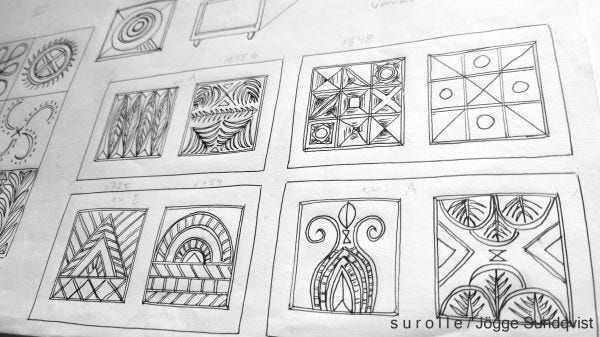
I really love drawing patterns! Mostly because my approach is constantly changing. What I thought was a good pattern six months ago can suddenly seem ill-conceived and uninspired, and another pattern that I composed many years ago, then rejected in my sketchbook, can now seem brilliant as long as I redraw it and change the proportions.
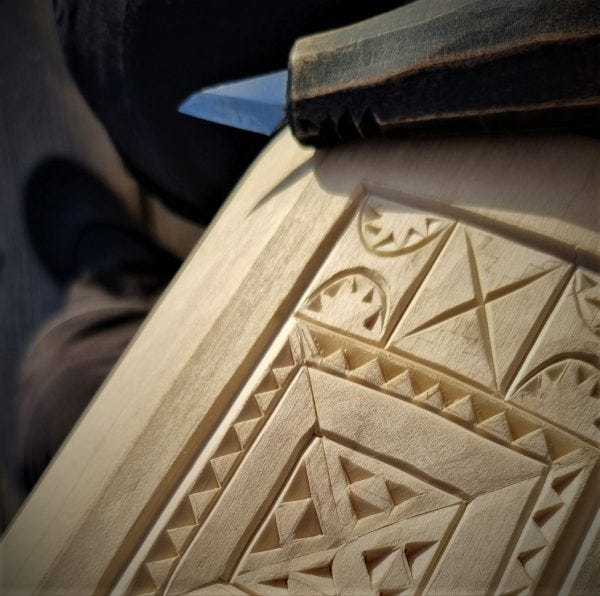
It's interesting why I have the feeling that it can always be better. For me, a good pattern should contain several repetitive bands of chips and lines, preferably with a well-balanced relationship between surfaces and lines. With a clear focus, a centre point that draws the eye and communicates something. It can be a pierced decoration, a flat cut, a text or a symbol that signals something important to me. The pattern should also stand the test of time. Maybe this is where the real difficulty arises?
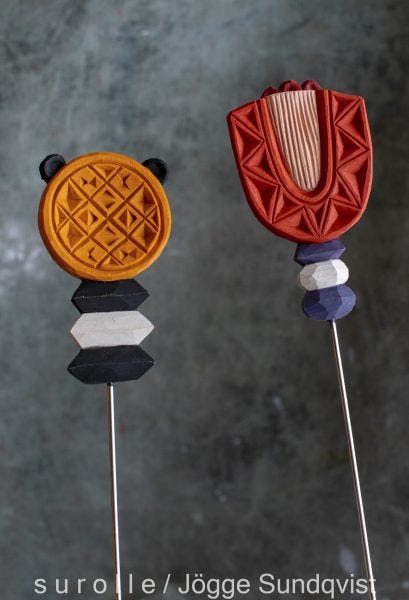
The cut should of course be clean and neat, but at the same time not be too fussy and stiff. I strive for an agile drive that has the knife running confidently in the wood fibres without anxiety. Of course the pattern should marry the object and speak the same language. And the cut should also skew a little charmingly, sparkle and crackle. It's hard to put my finger on how this happens, it's wonderful when it just happens, but I usually have to work on the ideas several times, preferably with time in between, before I'm satisfied.
One symbol I often use is the hourglass, it has become so personal that I feel it is a cornerstone of my pattern library. Maybe because it speaks to me.
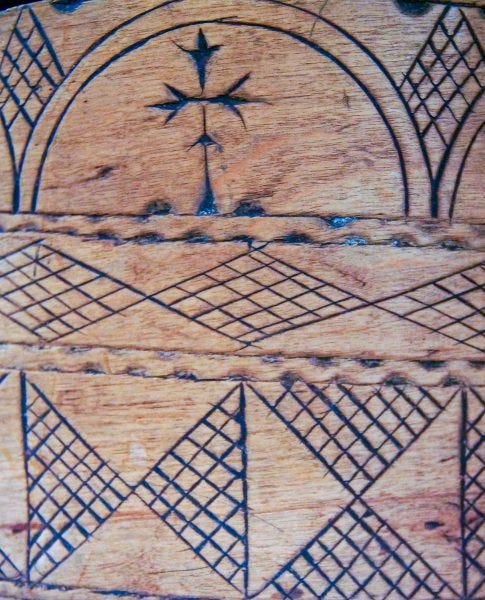
The hourglass consists of two triangles with the points facing each other. Ethnologists interpret the triangle with the point upwards as a masculine symbol and the one with the point downwards as a feminine one. When they are joined, it becomes a sign that time is running out, the sands are running in our collective hourglass and we are all going to die. But, in many popular cultures, it is also a symbol of love, of the union between woman and man. I once read in the magazine Hemslöjd that a Turkish weaver who had moved to Sweden was overjoyed when he found the hourglass among our folk pattern compositions. He referred to the symbol as ‘eternal love’.
Symbolically, the logic is crystal clear. The children, who will hopefully be the result of the love union, bridge the passage of time and new generations live on. A kind of counterfire against death. If the hourglass is drawn lying down, it becomes a symbol of eternity, a lying eight. Love sends us into eternity - a slightly abstract interpretation perhaps, but an existential thought to ponder.
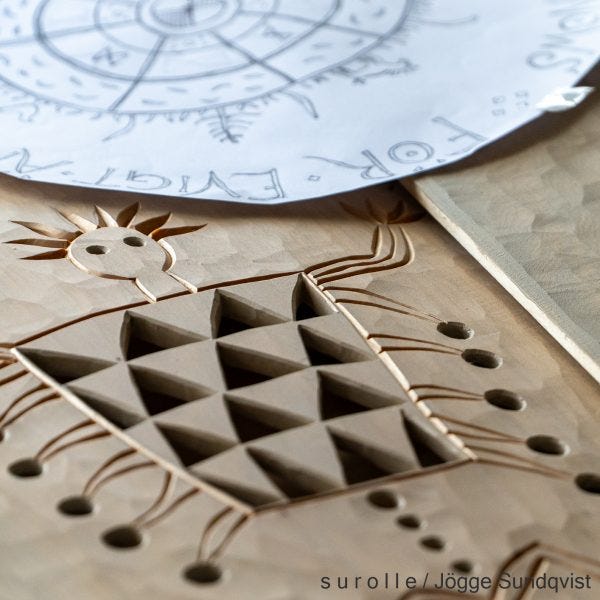
Sometimes I am asked if the pattern is made at the same time as the slöjd item. It happens during clear moments of pure inspiration, but it is rare. Often I have no idea. Then I usually sit and idle on the surface until something appears. Like the object is signalling what's appropriate. But if we're not ‘connected’, if it's completely dead, then I browse through my pile of sketchbooks for inspiration. If I don't find anything there, I use my image bank. There are pictures from museum archives and local outdoor museums that I have visited over the years. With a bit of luck, something clicks and an old pattern falls into a new context and becomes new again after some processing. When it gets a surolle touch, a manner or a look if you will, I start to feel confident.
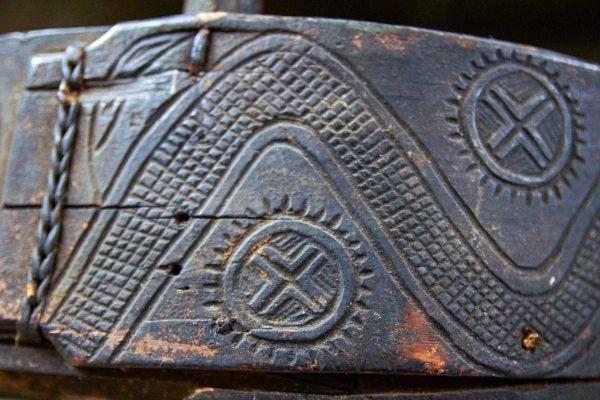
When I cut out the sketch from the paper and tape it to the object, I usually put it on the bedside table next to the bed. My most pure and self-critical moments happen before breakfast. The thought then feels clear and unprepared for self-deception. I immediately see if something is out of proportion or out of line and have to be redrawn.
Time-consuming? Of course, but the satisfaction when the pattern is cut and painted is the slöjd kick I live on. One of my strong driving forces to continue. Rock on and slöjd until you die...
What a great read ...so engaging like your books. Looking forward to meeting you at Saterglatan on your course! Greetings from Greece.
I’m so glad you’ve started a Substack jogge! I meet you in Damariscotta Maine 6 years ago at the library when was an apprentice at the Carpenters boat shop. Your signed copy is one of my cherished books. I go to a Japanese woodworking school in Kiso valley now and have been sharing your book with others!! Looking forward to reading more and thank for your generosity in sharing your passion, insight and craft